
Introduction
Most companies invest in cloud servers, security tools, and fast hosting. But still, downtime happens. In many cases, the real reason is not performance - it is poor architecture.
A common hidden issue is SPOF (Single Point of Failure).
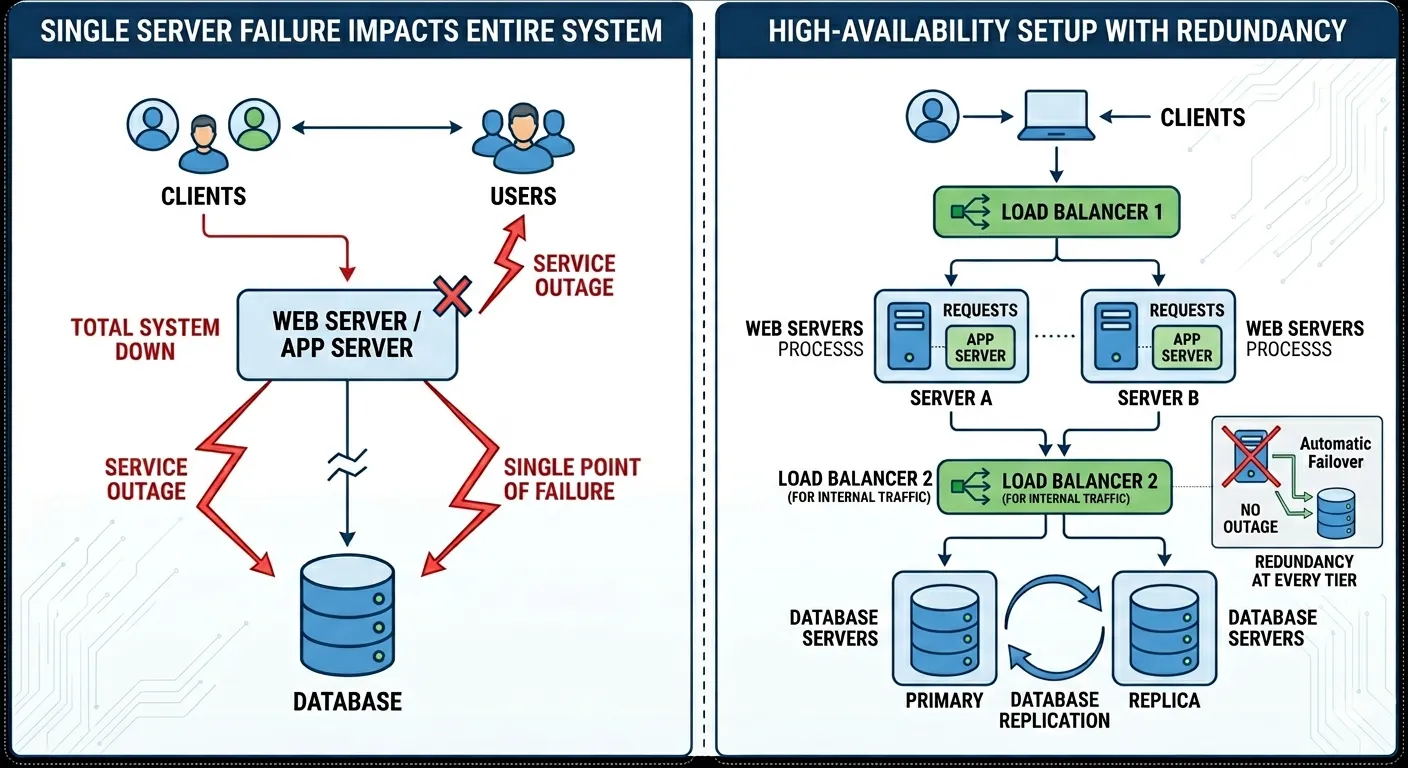
A Single Point of Failure means your business has one critical component that, if it fails, your entire system stops working.
This is one of the biggest infrastructure risks in 2026, especially for e-commerce websites, ERP systems, SaaS applications, and online portals.
What Is a Single Point of Failure (SPOF)?
A Single Point of Failure is any part of an IT system that is not backed up or duplicated. If it stops working, the entire service becomes unavailable.
Examples:
- Only one production server
- Only one database server
- One internet connection
- One load balancer
- One DNS provider
- One backup storage location
Why SPOF Is Dangerous for Businesses
1. Unexpected Downtime
If the only database server crashes, the application stops completely.
2. Revenue Loss
For online businesses, even 30 minutes of downtime can cause major revenue loss.
3. Brand Reputation Damage
Customers lose trust if your website is frequently unavailable.
4. Data Loss Risk
If backup is also a SPOF, you may lose critical business data permanently.
5. High Recovery Cost
Emergency fixes during downtime often cost more than planned infrastructure upgrades.
Common SPOF Examples in Real IT Infrastructure
1. Single Web Server
Many businesses host their website on one server. If the server hangs, disk fills up, or RAM overload happens—site goes down.
Solution: Use multiple web servers + load balancer.
2. Single Database Instance
One MySQL/PostgreSQL database means if DB fails, everything stops.
Solution: Database replication + failover setup.
3. Single Storage System
If the only disk or storage volume fails, application data becomes unavailable.
Solution: RAID + cloud storage replication + regular snapshots.
4. Single Internet Provider
If your office or data center depends on one ISP, your entire connectivity is at risk.
Solution: Dual ISP redundancy.
5. Single DNS Provider
Even if your server is running, DNS failure can make your website unreachable.
Solution: Multi-DNS providers or backup DNS configuration.
6. Single Backup Location
Many companies keep backups only on the same server.
If server crashes, backup is also gone.
Solution: Follow 3-2-1 backup strategy.
How to Identify SPOF in Your Infrastructure
Businesses should perform an SPOF audit by checking:
- Is there only one production server?
- Is database replicated?
- Is backup stored offsite?
- Is monitoring available 24/7?
- Is there a disaster recovery plan?
- Is failover configured?
- Is load balancing available?
A small audit can reveal major risks.
How to Fix SPOF and Build High Availability
1. Load Balancer Setup
A load balancer distributes traffic across multiple servers, ensuring the system stays live even if one server fails.
Popular options:
- Nginx Load Balancer
- HAProxy
- AWS ALB / ELB
2. Database Replication and Failover
Database redundancy is critical.
Solutions:
- MySQL replication
- PostgreSQL streaming replication
- AWS RDS Multi-AZ
- Automated failover cluster
3. Auto Scaling for Traffic Handling
Auto scaling ensures the infrastructure grows automatically during high traffic and reduces when traffic drops.
This prevents crashes and improves cost efficiency.
4. Backup and Disaster Recovery Planning
Use the 3-2-1 Backup Rule:
- 3 copies of data
- 2 different storage types
- 1 offsite backup
Also ensure backups are tested regularly.
5. Redundant Network and Firewall Setup
For business-critical applications, network redundancy prevents major outages.
6. Continuous Monitoring and Alerts
SPOF becomes more dangerous when there is no monitoring.
Use monitoring tools like:
- Zabbix
- Prometheus
- Grafana
- CloudWatch (AWS)
Monitoring helps detect failures before downtime occurs.
Benefits of SPOF-Free Infrastructure
When SPOF is removed, businesses experience:
Higher uptime (99.9% or more)
Improved customer trust
Faster recovery during incidents
Better performance under load
Reduced risk of business disruption
How Adglob Infosystem Helps Businesses Remove SPOF
At Adglob Infosystem, we help businesses build reliable and high-availability IT infrastructure by providing:
- Infrastructure audit and SPOF identification
- Load balancing setup (Nginx/HAProxy/AWS)
- Database replication and backup configuration
- Server monitoring and alert management
- Cloud infrastructure design (AWS, Azure, GCP)
- Disaster recovery planning and implementation
Our goal is to ensure your business stays online with minimal downtime.
Conclusion
Single Point of Failure (SPOF) is one of the most common but ignored risks in IT infrastructure. Many businesses realize it only after facing downtime.
By implementing redundancy, failover, monitoring, and proper backup planning, businesses can eliminate SPOF and ensure stable operations.
If you want a secure and high-availability infrastructure, Adglob Infosystem can help you design and manage it professionally.