
Introduction
MySQL has been one of the most widely used databases for years and works well for many small and medium-scale applications. However, as business applications grow in complexity, data volume, and user traffic, MySQL often starts showing performance bottlenecks.
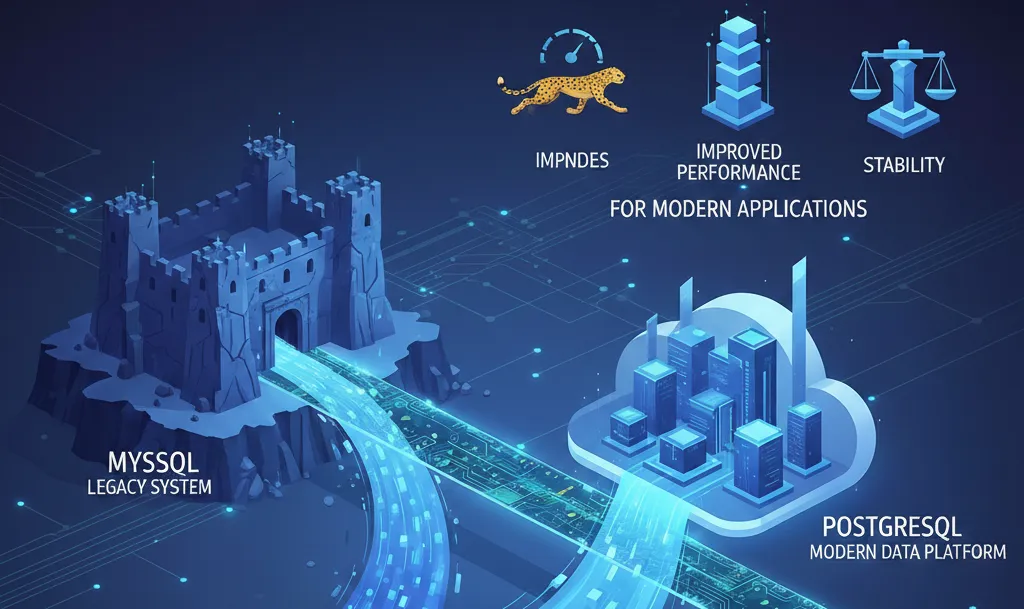
To overcome these limitations, many organizations are now moving to PostgreSQL—a powerful, enterprise-grade open-source database known for performance, scalability, and reliability.
Common Challenges with MySQL
1. Performance Bottlenecks with Large Datasets
MySQL can struggle with complex joins, analytical queries, and large datasets, especially under heavy load.
2. Concurrency and Locking Issues
High-traffic applications often face locking and transaction conflicts in MySQL, leading to slower response times.
3. Limited Advanced Features
Compared to PostgreSQL, MySQL lacks advanced indexing options, robust JSON handling, and complex query optimization features.
4. Scalability Constraints
Scaling MySQL for write-heavy workloads often requires complex replication or sharding strategies.
5. Data Integrity Concerns
PostgreSQL strictly follows SQL standards and enforces stronger data consistency and integrity rules.
Why PostgreSQL Is the Preferred Choice
1. Superior Query Performance
PostgreSQL is highly optimized for complex queries, large datasets, and analytical workloads.
2. Advanced Indexing and Features
PostgreSQL supports GIN, GiST, and BRIN indexes, JSONB data types, full-text search, and stored procedures.
3. High Concurrency and Stability
PostgreSQL handles multiple simultaneous transactions efficiently, making it ideal for high-traffic applications.
4. Strong ACID Compliance
It ensures reliability and consistency—critical for financial, healthcare, and enterprise systems.
5. Enterprise-Ready Open Source
PostgreSQL is free, open-source, and trusted by enterprises worldwide.
When Should Businesses Consider Migration?
Businesses should consider migrating when:
-
Application performance degrades despite optimization
-
Data volume and complexity increase
-
Reporting and analytics become slow
-
Long-term scalability is required
-
Data integrity and compliance are critical
How MySQL to PostgreSQL Migration Works
1. Assessment & Planning
Database schema, queries, and application dependencies are analyzed.
2. Schema & Data Conversion
Tables, indexes, and constraints are converted to PostgreSQL-compatible formats.
3. Data Migration
Data is migrated using tools likepgloaderor custom migration scripts.
4. Testing & Validation
Application functionality, performance, and data consistency are tested.
5. Go-Live & Monitoring
Traffic is switched, and performance is continuously monitored.
How Adglob Infosystem Supports Database Migration
At Adglob Infosystem, we offer complete database migration services:
-
MySQL to PostgreSQL migration
-
Minimal or zero-downtime strategies
-
Query optimization and performance tuning
-
Cloud database support (AWS, Azure, GCP)
-
Post-migration monitoring and support
Our expert team ensures a smooth, secure, and reliable migration without disrupting business operations.
Conclusion
As business applications grow, database performance becomes critical. PostgreSQL provides better performance, scalability, and data integrity compared to MySQL. Migrating to PostgreSQL is a strategic decision that helps businesses build stable and future-ready applications.
Partner with Adglob Infosystem to migrate your database confidently and unlock better performance.