Introduction
Artificial Intelligence has become a major part of modern business operations. Companies are using AI for:
- customer support chatbots
- automated email replies
- document generation
- business reports
- code generation
- internal knowledgebase assistants
But there is one serious issue businesses must understand before depending fully on AI:
AI can generate wrong answers confidently.
This issue is called 'AI hallucination', and it is one of the biggest challenges in AI adoption today.
What Is AI Hallucination?
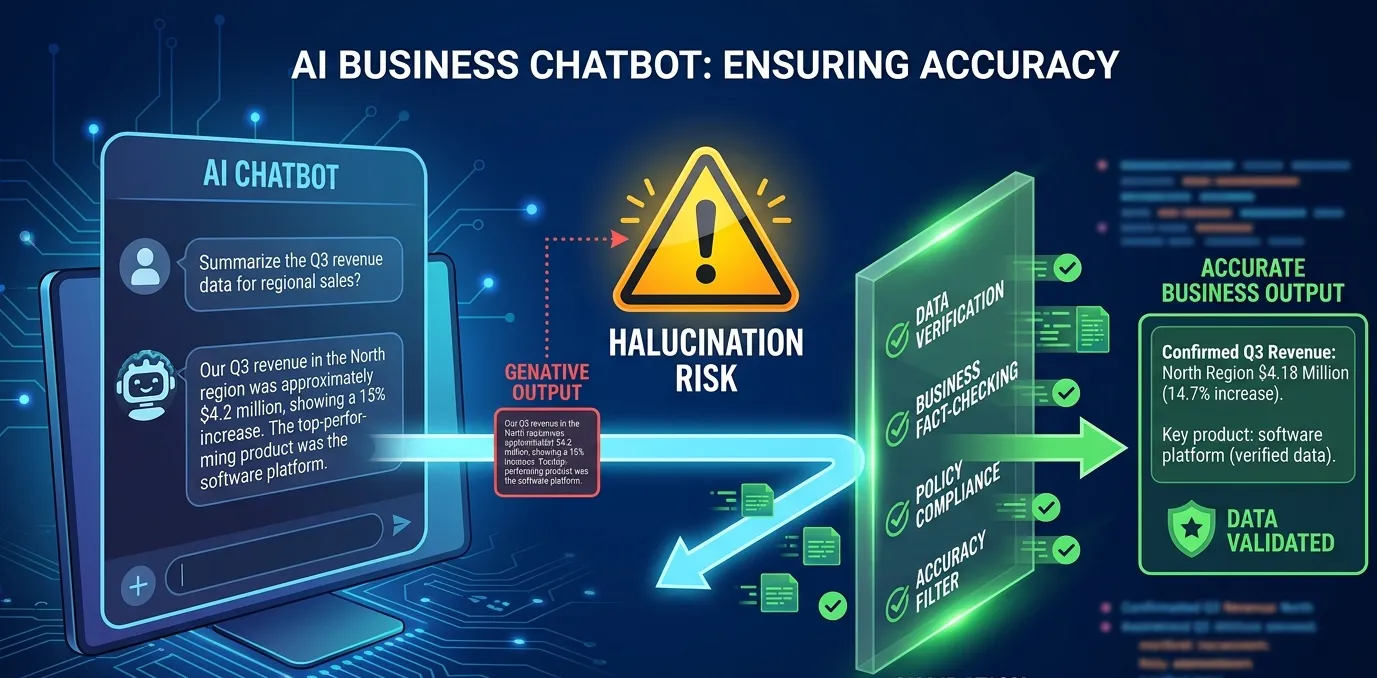
AI hallucination happens when an AI model produces output that sounds correct but is actually false, inaccurate, or made up.
For example:
- giving incorrect product pricing
- generating fake technical steps
- suggesting wrong medical/legal information
- creating non-existing policies or procedures
- misinterpreting internal company data
The output looks professional, but the information may be wrong.
Why AI Hallucination Happens
AI models generate responses based on patterns in training data. They do not “think” like humans.
Common reasons hallucinations occur:
1. Lack of Correct Context
If the AI does not have access to your internal database or documents, it will guess.
2. Poor Prompt Design
If questions are unclear, AI responses become unreliable.
3. Outdated Training Knowledge
AI may not know recent updates unless connected to real-time sources.
4. Complex Questions with Missing Data
If AI cannot find the answer, it may still respond with fabricated details.
5. Language and Interpretation Issues
Sometimes AI misunderstands industry terms, policies, or local business rules.
Real Business Risks of AI Hallucination
1. Wrong Customer Support Responses
If AI chatbot gives incorrect support steps, customers may lose trust.
Example:
- AI suggests wrong troubleshooting steps
- customer data loss occurs
- company reputation is damaged
2. Incorrect Billing or Pricing Information
If AI generates wrong price details, customers may demand discounts or raise disputes.
3. Wrong Business Reports and Analytics
AI-generated insights may mislead management decisions if the data is not verified.
4. Compliance and Legal Risk
If AI generates false legal or compliance advice, it can lead to serious penalties.
5. Technical Errors in Automation
AI-generated scripts or configuration suggestions can break servers or applications.
This is especially risky in DevOps environments.
How Businesses Can Reduce AI Hallucination
1. Use AI with Verified Data (RAG Approach)
Instead of letting AI guess, businesses should connect AI with real internal documents.
This is done using a concept called:
Retrieval-Augmented Generation (RAG)
RAG ensures AI responds based on company-specific data like:
- FAQs
- support documentation
- product policies
- internal SOPs
- knowledgebase articles
This makes AI far more reliable.
2. Implement Output Validation Rules
AI outputs should pass validation rules before being shown to users.
Example:
- verify email format
- verify pricing from database
- confirm order status from CRM
- validate dates and invoice values
3. Limit AI Responses to Approved Topics
A smart chatbot should be trained to say:
“I don’t have enough information to answer that.”
This is better than giving a wrong answer.
4. Human Approval for Critical Tasks
For sensitive processes like:
- financial reporting
- legal communication
- contract generation
AI should assist, but final approval must be human.
5. Use Structured Prompt Templates
Businesses should standardize prompt formats like:
- clear role definition
- strict response format
- limit response length
- include fallback response rule
This reduces randomness.
6. Continuous Monitoring and Improvement
AI chat logs should be reviewed regularly to identify:
- wrong answers
- repeated customer complaints
- inaccurate knowledge areas
Then the knowledgebase must be updated.
Where AI Hallucination Can Be Controlled Best
AI hallucination is most controllable in:
- customer support automation
- internal helpdesk systems
- HR policy chatbots
- ticketing system automation
- product information assistant
Because these systems use structured and verified data.
AI Hallucination vs AI Error: What’s the Difference?
A normal error occurs when a system fails.
But hallucination is dangerous because:
- AI generates wrong output
- output looks confident and professional
- user trusts it
- business suffers losses
That’s why hallucination is a critical risk in AI adoption.
How Adglob Infosystem Helps Businesses Implement Safe AI
AtAdglob Infosystem, we help companies implement AI solutions with accuracy and control.
Our AI implementation includes:
- AI chatbot development for websites & WhatsApp
- AI integration with internal knowledgebase
- RAG-based AI assistant setup
- secure AI infrastructure deployment
- monitoring and response optimization
- controlled AI automation workflows
We ensure your AI system remains helpful, reliable, and safe for business operations.
Future of AI: Trustworthy AI Systems
In 2026 and beyond, AI adoption will increase massively. But businesses will demand:
- accurate AI responses
- controlled automation
- compliance-ready AI systems
- data privacy and security
Companies that buildtrustworthy AI systemswill gain the biggest advantage.
Conclusion
AI hallucination is one of the most important risks businesses must understand before relying heavily on AI tools. While AI can improve productivity, wrong outputs can cause financial loss, customer dissatisfaction, and legal issues.
By using verified data sources, implementing validation rules, and maintaining continuous monitoring, businesses can reduce hallucination and safely use AI for growth.
For secure AI chatbot and automation solutions, Adglob Infosystem can help your business adopt AI with confidence.